
The second international tdAcademy Summer School took place in 2023 and found positive resonance once again. 19 Master and PhD students with very different disciplinary and geographic backgrounds came together in Bad Freienwalde from 17th to 22nd September to learn about transdisciplinary methods and to apply them in an exemplary way to questions in rural areas of north-eastern Brandenburg. For all participants, this was an exciting and enriching continuation of the Summer School cooperation between the tdAcademy team at the ZTG and the ISST of the Universitat Politècnica de Catalunya (UPC).
The Summer School was developed by Martina Schäfer, Emilia Nagy and Josefa Kny (tdAcademy/ZTG) as well as Gemma Tejedor and Jordi Segalàs (ISST/UPC). Annabell Lamberth (ZTG) and Na Liang (UPC) were involved in the organization. The project was developed as part of Gemma Tejedor's tdAcademy Fellowship at ZTG in 2022. See also Report on the Website of the UPC.

Source: Julia Margeth Theuer, 2023
Transdisciplinary research and practice is about bringing together knowledge and perspectives from different actors in science and society. The purpose is dual: to contribute to the solution of real-world problems and, at the same time, to provide new insights for science.
Source: Emilia Nagy, 2023
Collaboration across institutions and beyond the boundaries of one's own discipline and academia is not a self-evident or simple exercise. In order to better understand the challenges and to be able to address them in a more targeted way, expertise is required that can often only be acquired in transdisciplinary practice through learning by doing.
Comment of the participants: „Transdisciplinarity is not an easy and well understood thing for everyone. And there is not enough of transdisciplinarity in research and practice. We need building more bridges.“
The organizers of ZTG and ISST considered a one-week summer school as a possible short cut for gaining this expertise. During the summer school, the participants got familiar with the theoretical foundations and methods of transdisciplinary project design. Using the example of land use conflicts and innovative approaches for the rural, low populated, agricultural region in the northeast of Brandenburg, the participants formulated transdisciplinary research questions and tested methods for the design of the participation concept and for impact assessment in small groups.

Souce: Emilia Nagy, 2023
The Master's and PhD students focused their exemplary projects on a self-defined realistic regional problem. They worked in groups with mixed disciplinary and geographic background. To choose a region-specific topic, we organized a field trip to exciting places in the region where land use conflicts and good examples of solutions are evident. For example, we visited Gut Kerkow, which combines species-appropriate animal husbandry and meat processing with bio-energy production for self-sufficiency in a holistic approach. The estate supplies meat for Berlin's organic market and is also expanding its local tourism offerings. Ole Bernhardt and Manuel Pundt shared the vision and challenges of this organic farm with us in a very lively way.

Source: Emilia Nagy, 2023
At the NABU information center in Blumberg, the head of the Schorfheide-Chorin biosphere reserve, Dr. Martin Flade, gave us an introduction to the concept of the biosphere reserve and explained the reasons for land use conflicts in the region. In addition to a high proportion of protected areas and organic farming, the region is also characterized by numerous renewable energy production facilities and intensive pig and chicken farming.
NABU (Naturschutzbund Deutschland e. V.) has been committed to nature conservation and environmental protection for more than 120 years. The head of NABU Brandenburg, Björn Ellner, visited us one evening and provided the participants with insights on a current regional land use conflict. In Bad Freienwalde, an investor wants to clear 370 hectares of mixed forest with high biodiversity for the installation of a photovoltaic plant – demonstrating very clearly the trade-off between economic interests of the community and nature conservation.
In the House with a Future in Angermünde, the participants learned from Nadine Binias how a vacant house can be turned into a communitarian place in cooperation with the city management and via scholarships for start-ups and other local initiatives. Jan Lindenberg presented the relevance of the House with a Future and the Angerwerk for the continuation of the innovation management of the R&D alliance WIR! region4.0. The regional University for Sustainable Development in Eberswalde plays a central role in regional transformation processes. During a visit to the university, Ralf Bloch reflected on the question of whether organic farming in northeastern Brandenburg is a success story, and Uta Steinhardt gave an overview of the different concerns that are taken into account in regional planning when designating areas for the generation of wind energy.

Source: Emilia Nagy, 2023
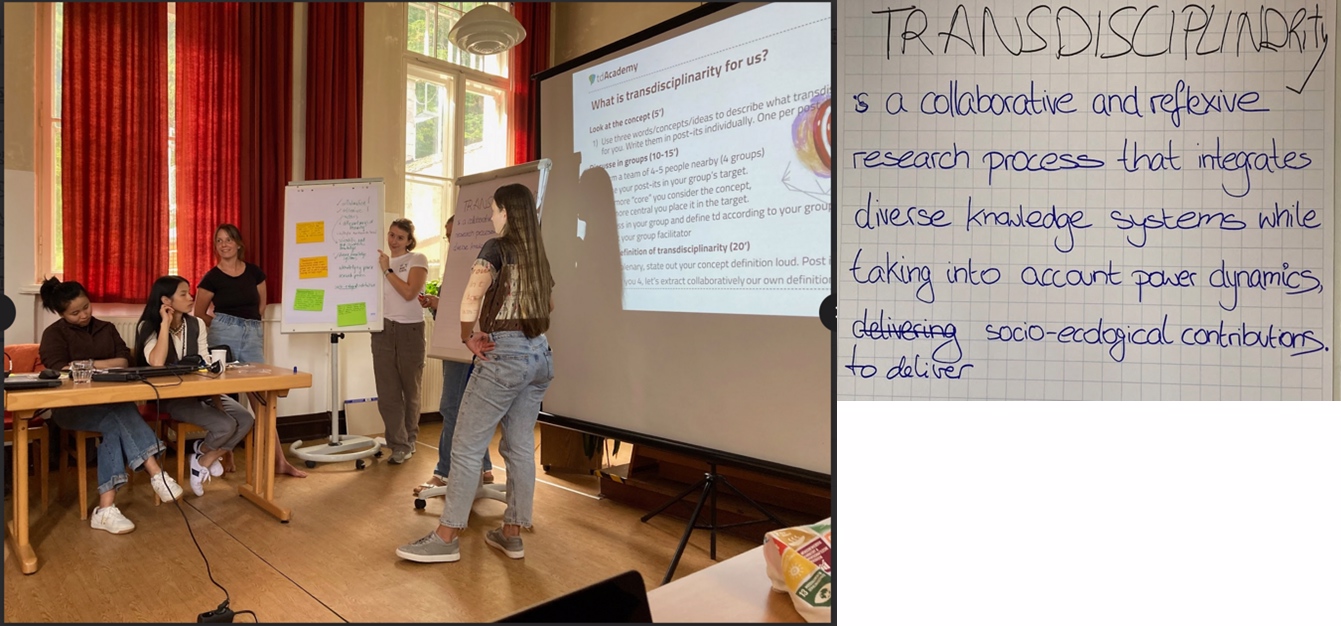
The methodological program of the summer school was structured according to steps in the design of a td project. Inputs and practical exercises alternated so that the groups could design their own project step-by-step. We started with the question what transdisciplinarity means and the participants defined their common understanding of transdisciplinary research. Subsequently, we formulated transdisciplinary research questions based on societal problems that the groups wanted to address. Together we conducted a constellation exercise to better understand the positions of actors based on the example of a research question. The participants developed their participation concepts as well as formats for knowledge integration. For this purpose, they also received an overview of various collections and toolboxes on transdisciplinary methods. In a role play based on the Theory-of-Change method, they discussed the intended and non-intended effects of their developed projects. While walking, we discussed open questions and challenges around transdisciplinary research. Many participants asked about future options for transdisciplinary researchers in the academic system.
Insight by students: “I particularly liked when we talked about the different methods used in TD research and how they can come together to create a TD project. The input from the first day of excursions was also really nice.”
On the last day, the participants presented their results to interested persons from HNEE, ZTG and UPC in a Zoom meeting.
The visions of the 4 projects
Strengthen rural communities’ capacity for creative self-organisation to improve quality of community life.
Re-wetting is more accepted as an evidence-based and integrated agriculture and nature conservation practice, that can sustain livelihoods in our region.
To improve multi-generational mobility and contribute to sustainable and prosperous rural communities where citizens from different generations can thrive together.
The joint vision is to create a toolkit that highlights sustainable benefits and integrates the perspectives of actors towards implementing renewable energy. We want to take lessons learned in this case study to apply elsewhere.

Source: Martina Schäfer, 2023
In this second session of the summer school, it was again possible to gather applicants with different geographicbackgrounds from different countries (Ireland, Scotland, Luxembourg, Switzerland, Ethiopia, Spain, the Netherlands, China, Russia).
There were participants with very different professional and experience backgrounds (balanced ratio of master students and PhD students), so that the participants could learn a lot from each other. Some were already able to bring their first experiences with transdisciplinary research into the group work, for others it was a completely new topic. In the final round, a more intensive exchange on individual methods that enable the overcoming of challenges in transdisciplinary projects was desired.
Insight by students: “We didn't go into the potential difficulties and pitfalls of conducting a transdisciplinary project. Tools for collaboration, mediation and communication between diverse and opposing stakeholders would be useful. A role-play stakeholder discussion could be interesting for example, to highlight the difficulties of power dynamics in open discussions.”
The conception of a summer school is always a balancing act between imparting conceptual and methodological knowledge and sufficient time for individual development. The next summer school offers us the opportunity to optimize our concept with regard to the participants' suggestions.
Insight by students: “Most centrally I learned how to frame and plan a transdisciplinary project. The lack of methodologies provided, although a negative of the course for some, actually gave me more confidence to explore and develop new methods. I learned that transdisciplinarity is a very useful approach to overcoming barriers to understanding other ways of knowing and therefore really useful for study areas like decolonisation.”